


Even though the tourism sector has undergone an unprecedented digital transformation, it still carries a weight that affects both company profitability and user experience: the management of uncertainty. In a world where travelers expect seamless interactions, the lack of clarity regarding international rules remains a significant barrier. One of the main points of friction in international travel sales is the lack of knowledge regarding entry requirements. When a traveler discovers, after having paid for their reservation, that they do not meet the migration conditions, the result is usually a request for a refund and an overload on customer service departments.
As industry professionals, we know that reducing the volume of support tickets is not just a matter of operational efficiency, but of financial survival. Every refund request represents a double loss: the revenue itself and the operational cost of the staff handling the claim. The key to mitigating these problems resides in offering the necessary information at the precise moment it is needed. It is not about overwhelming the client with infinite legal texts or fine print, but rather integrating technological solutions that filter relevant data during the search, checkout, and post-purchase stage. In this context, data accuracy becomes the most powerful sales tool for any agency or airline seeking to build audience loyalty.
Clarity from the first search
The phase of inspiration and search is the first point of contact where demand can start to be filtered effectively. Many online travel agencies make the mistake of hiding travel restrictions until the last step of the process. This practice creates a false expectation for the user and represents a latent risk for the business, as it leads to high abandonment rates late in the funnel. If a traveler with a passport from a specific country tries to look for flights to a destination that requires a complex visa to obtain, it is essential that the platform issues a preventive warning immediately.
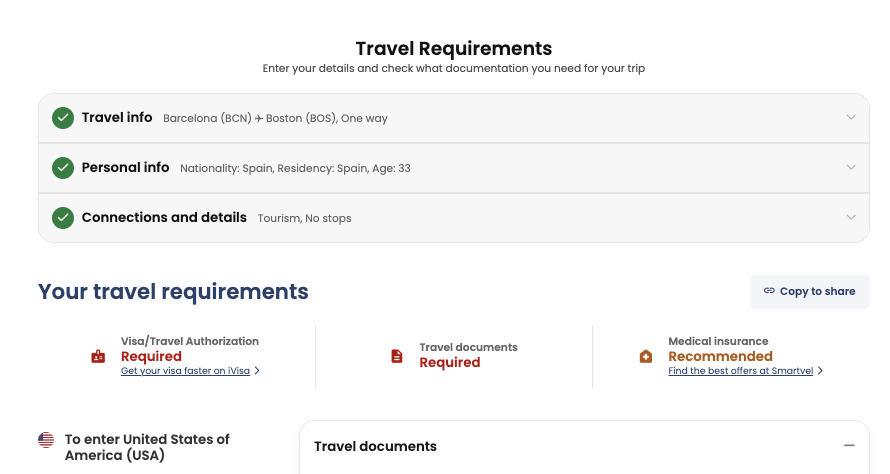
Implementing tools like Entrydocs by Smartvel allows the visualization of requirements to be carried out in real time, adapting to the specific profile of the user. By showing this information during the search, the abandonment rate in the shopping cart is drastically reduced and, most importantly, it prevents the customer from buying a product they will not be able to enjoy. This level of transparency establishes a standard that the current market demands, positioning the brand as an expert advisor rather than just a transaction processor. When the user feels that the platform cares for them from the first click, confidence increases and the probabilities of future claims due to lack of information are reduced to a minimum. It is not just about selling a ticket, it is about ensuring that the trip is viable from the start.
Total security during checkout
The checkout is the critical moment where the transaction is consolidated and where the conversion rate is put to the test. At this point, the information regarding visas and health documents must be specific, personalized, and, above all, binding. It is no longer enough to include a generic link to an external government website that the user probably will not read.
In the fast-paced digital economy, the integration of solutions that automatically verify requirements based on the nationality and destination of the passenger is essential to shield the sale.
By integrating Entrydocs into the payment process, the system detects if the destination requires an additional document and communicates it assertively. The payment process can include an explicit confirmation that the user knows these conditions, which acts as a legal and operational insurance for the company. If the traveler accepts that they have been
properly informed, the probability that they will try to process a refund due to lack of documentation decreases significantly. Additionally, automating this process lightens the load on support agents, who stop answering basic questions about passports to focus on higher value-added tasks. The goal is to turn a possible administrative obstacle into a customer service opportunity that reinforces purchase security and total transparency.
Value added post-purchase
The work of a tourism platform does not end when the customer clicks pay and receives their confirmation email. The post-purchase stage is fundamental to avoid last-minute surprises that end in desperate calls to the support center days before departure. Immigration laws and health requirements are dynamic, often changing in a matter of hours or days. For this reason, sending transactional communications with real-time updates is the best strategy to maintain control of the situation.
An automated alert system that notifies the traveler of any change in their destination is the best tool to reduce customer anxiety and prevent cancellations. By keeping the traveler informed proactively, the company anticipates the need to open a ticket and manages the relationship with the traveler before a problem arises. This type of communication must be direct, short, and easy to read from mobile devices, ensuring that the passenger arrives at the airport with all documentation in order. By using technology specialized in monitoring restrictions, travel companies can guarantee that their customers never feel helpless during their journey. This proactivity not only reduces costs derived from cancellations, but also transforms a simple transaction into a long-term loyalty relationship.
The reduction of refunds and the optimization of operational costs necessarily involve an intelligent and timely management of data. Providing the correct information at the precise moment not only protects the profit margin of the companies, but also guarantees that the traveler enjoys a fluid experience without setbacks. Transparency and the capacity for anticipation are the most valuable assets that a travel brand can offer to its community of travelers in today’s complex global landscape.