

For a travel company, gaining visibility in destination-related searches is just the first step. The real opportunity lies in connecting with travelers as they begin to map out their trip and get closer to a purchasing decision, offering them an experience that helps them move from inspiration to planning, and ultimately, to action.
In this context, a trip planner can become much more than just an add-on feature. When executed well, it allows you to bring together destination content, recommendations, and itineraries in a single environment while simultaneously creating new user touchpoints before, during, and after booking.
The question for many agencies, OTAs, hotel chains, or airlines is how to incorporate this capability. Does it make sense to build a Trip Planner from scratch, or is it more efficient to integrate a specialized solution? The answer depends on each company’s resources, goals, and required level of customization, but there is a common starting point: understanding which searches we want to capture and what experience we provide afterward.
From Search to Purchase Intent
Not all travel-related searches hold the same commercial value. A query like “what to see in Paris” might correspond to an early inspiration phase. On the other hand, searches like “what to do in Paris in 3 days,” “Paris itinerary with kids,” or “best restaurants near the Eiffel Tower” reflect a much more specific need: the traveler is already envisioning their trip.
This opens up an opportunity for travel brands. Instead of just ranking informational pages, they can create content that addresses specific needs and connect those searches with tools that keep the planning process moving forward.
This is where the term trip planner becomes especially relevant. A page optimized for this intent can explain how to organize a trip, offer ideas for building an itinerary, and, above all, allow users to transition from reading to planning their own journey.
The key is not to separate SEO from product. Content draws the user in, while the planner provides a tool to move forward. This connection can be particularly valuable for an OTA looking to drive activity bookings, a hotel aiming to increase stay value, or an airline wanting to keep passengers within its digital ecosystem.
Build or Buy
Developing an in-house Trip Planner offers a high degree of control. The company can define the user experience, decide what data to display, connect it to its tech stack, and fully adapt it to its internal processes. For organizations with specialized tech teams and highly specific needs, this can be a viable path.
However, building a planner isn’t just about designing an interface. You also have to solve for content availability and updates, connections to various data sources, itinerary creation, filtering, personalization, mobile experience, and ongoing maintenance. Plus, if the goal is to cover multiple destinations, the complexity scales up significantly.
The alternative is to integrate a specialized solution. In this model, the travel brand leverages pre-built technology and focuses its resources on customer experience, content strategy, and conversion. Integration can be done via API or widget, depending on the desired level of control over the UI.
In Smartvel’s case, our Trip Planner generates customized itineraries based on traveler preferences and trip duration, as well as building routes from favorite spots. The platform combines points of interest, restaurants, tours, activities, and events, allowing the use of Smartvel’s content, proprietary inventory, or a mix of sources.
Therefore, the decision shouldn’t just be framed as “in-house vs. vendor”. It’s also worth asking which part of the experience should be our differentiator and where it makes the most sense to invest internal resources.
The Trip Planner as a Conversion Layer
A planner’s value doesn’t end once the user generates an itinerary. Its true potential unlocks when integrated with the rest of the company’s digital ecosystem.
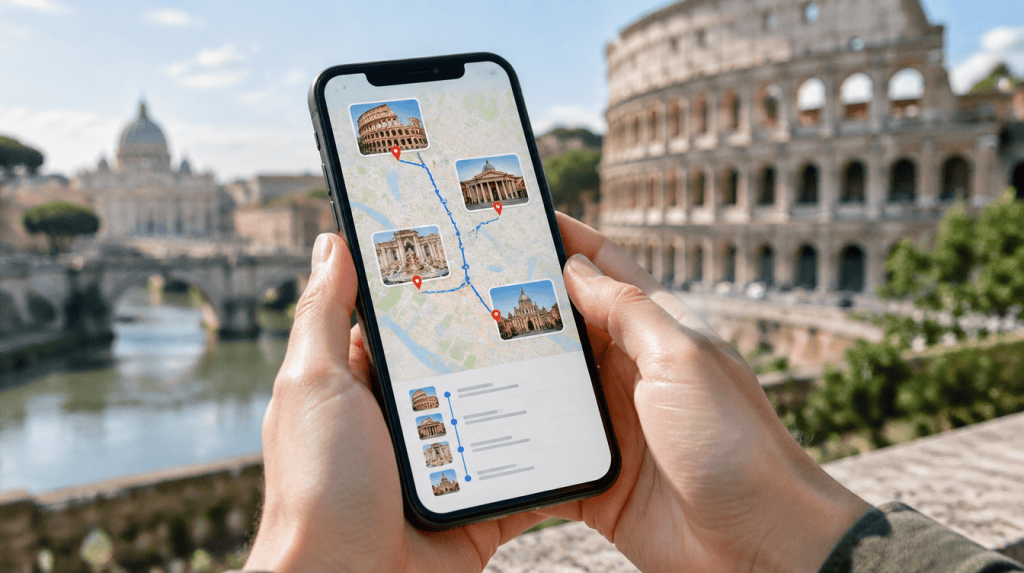
A search for “what to do in Rome in four days,” for instance, can lead to an SEO-optimized landing page. From there, the user can access a Trip Planner featuring Rome-related content and start crafting their journey. If the company can also link those recommendations to hotels, flights, activities, transfers, or its own services, the planner seamlessly bridges the gap between inspiration and booking.
This is especially relevant because the user journey is rarely linear. They might get inspired by an article, check an itinerary, save a few spots, and come back days later to book. An integrated planning experience allows you to support that journey without forcing them to leave your platform to hunt for information elsewhere.
For a hotel chain, the planner can be part of the pre-arrival experience, showcasing activities or services tied to the stay. For an airline, it can become an extension of the journey beyond the flight itself. And for an OTA, it can strengthen post-booking customer relations and open up new cross-selling opportunities. These are all use cases that Smartvel encompasses within its Trip Planner offering for travel companies.
A Choice Between Technology and Strategy
The “build or buy?” question should actually be answered with another: What are we trying to achieve with the trip planner?.
If the priority is to develop a completely proprietary tech experience—and you have the bandwidth and time to maintain and evolve it—in-house development can make sense. If the goal is a rapid time-to-market for a planning tool, expanding destination coverage, and reducing the content maintenance burden, a specialized solution is likely a better fit.
In either case, success relies on something beyond the technology itself: connecting high-intent searches with a useful experience and a clear path to conversion.
A Trip Planner shouldn’t be an isolated feature on a travel website. It can serve as the sweet spot where SEO, destination content, personalization, and product intersect. The real opportunity is ensuring that a user who arrives looking for inspiration also finds a reason to stay, plan, and, whenever they’re ready, book.
Technology can facilitate that journey. Strategy is about designing it.