

In an increasingly digital world, travelers are no longer satisfied with simply booking a flight or reserving a hotel: they want to discover experiences, visualize destinations, and plan their journey in an intuitive way. This is where the Travel Map Widget comes into play, an interactive tool that transforms the way travel brands present their content.
A map is no longer just a location element; it has become a resource to inspire, guide, and build trust. With the right technology, a travel map widget can display everything from nearby attractions to local events, providing travelers with all the information they need without leaving the airline, hotel, or OTA website.
More Than a Map: An Interactive Experience
The value of a Travel Map Widget lies in its ability to turn the abstract into something tangible. When a user browses an airline’s website and sees a dynamic map with connected destinations, they don’t just understand the flight network—they picture themselves in those places. The same applies to hotels: by visualizing on a map what to do around an accommodation, the traveler perceives the added value of its location.
This kind of resource doesn’t just provide information, it also sparks emotions. An interactive map showing festivals, popular restaurants, or hidden beaches immediately creates a sense of closeness and relevance. The customer is not only thinking about booking, but about everything they will experience upon arrival.
Smartvel’s Role in the Evolution of Travel Maps
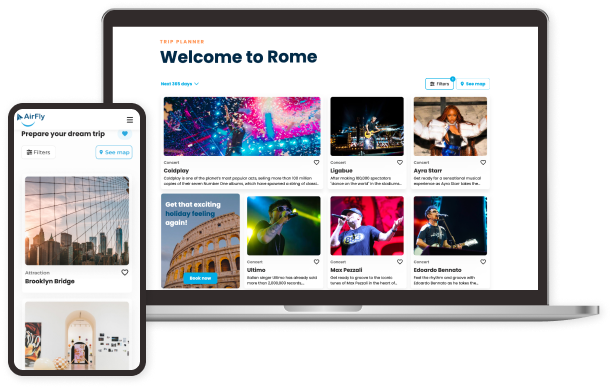
In this context, Smartvel has developed one of the most advanced solutions in the industry: content widgets and interactive maps that integrate destination information updated in real time. It’s not just about placing a dot on a map, but about enriching it with layers of data that truly matter to travelers:
- Cultural, sporting, or gastronomic events happening during the travel dates.
- Must-see attractions in each city, from iconic landmarks to hidden gems.
- Local recommendations that provide context, inspiring travelers and building trust.
This approach turns the map into a strategic tool for airlines, OTAs, hotel chains, and tourism boards. It’s not the same to show a static list of activities as it is to allow travelers to explore visually, filter what interests them, and create their own experience before even making a purchase.
Inspiration That Drives Conversion
One of the biggest challenges in the tourism sector is shortening the gap between inspiration and booking. Users may spend hours browsing social media, blogs, and third-party websites before making a decision. A well-integrated Travel Map Widget reduces that dispersion: the traveler finds all the information within the brand’s digital ecosystem.
This has a direct impact on conversion. For example, an OTA that incorporates a map with activities and experiences around a hotel is not just showing where to sleep, but why that hotel is the best option. An airline that allows customers to visualize destinations available from a city helps them decide faster and with greater confidence.
The key is for the widget not to be a decorative addition, but a fully integrated piece of the customer journey. When connected to the brand’s strategy, the map doesn’t just inform—it guides toward action.
Personalization and Real-Time Relevance
Today’s traveler expects the information they receive to be personalized and relevant. Showing a generic list of attractions that are closed or don’t match the travel dates is useless. This is where Smartvel’s differential value becomes clear.
Its widgets are not static; they are powered by dynamic content updated automatically. This means that if a traveler is planning a getaway to Paris next month, the map will show them the events, exhibitions, and activities available precisely during those dates.
Furthermore, the ability to filter by interests—culture, gastronomy, nature, nightlife—turns the tool into something alive, adapted to each type of traveler. What’s relevant for a family (parks, kid-friendly activities) is not the same as for a business traveler, who may be looking for nearby restaurants or afterwork plans.
A Competitive Advantage for Airlines, OTAs, and Hotels
Implementing a Travel Map Widget is not just an aesthetic resource: it is a competitive advantage. In a saturated market, where the difference between one website and another can be minimal, offering an interactive map with destination content makes a difference.
- Airlines: visually showcase their route network while also inspiring travelers with what they can do at each destination.
- OTAs: transform hotel pages into discovery spaces, showing what’s around and generating more confidence in the choice.
- Hotel chains: highlight the value of their location, helping travelers picture everything they can experience while staying there.
In all cases, the brand’s positioning is strengthened as a travel expert, not just as a service intermediary.
The Future of Travel Maps
The road ahead for Travel Map Widgets goes far beyond the visual. Integration with technologies such as conversational AI will allow travelers to interact with the map naturally, asking for personalized recommendations or designing their itinerary with a virtual assistant.
We will also see stronger connections between maps and critical travel phases: from initial inspiration to managing the trip once in destination. Imagine opening your airline’s app and not only checking your flight status but also seeing a map with nearby plans around your hotel for that very night.
These kinds of solutions strengthen loyalty and create new monetization opportunities, such as partnerships with local experience providers.
Why Now Is the Time to Bet on Them
The post-pandemic context has accelerated digitalization and reshaped traveler expectations. Today, over 70% of travelers seek digital inspiration before booking, often comparing multiple sources. In this scenario, offering a Travel Map Widget that centralizes high-quality information within the brand’s ecosystem becomes a way to retain users and increase conversion.
Moreover, this is not a complex solution to implement. Smartvel’s widgets are designed to integrate easily into websites and apps, with responsive design adaptable to each brand’s identity. This allows airlines, OTAs, and hotels to add a differentiating value without needing to develop tools from scratch.

In short, the Travel Map Widget has become a key piece in the digital strategy of travel companies. A tool that inspires, informs, personalizes, and converts.