
In today’s global tourism landscape, accessibility has ceased to be a secondary option and has become a fundamental right for every traveler.
However, the reality for people with reduced mobility (PRM) is often different. When planning a flight, they face a tangle of rules that vary by airline and airport, creating unnecessary complexity. This fragmentation of information leads to profound uncertainty and, ultimately, stress that overshadows the excitement of discovering new destinations.
As we highlighted in our article flying with reduced mobility, the true challenge does not always lie solely in physical barriers; often, the main problem is the lack of clarity in processes and informational misalignment. To bridge this gap, we have involved real travelers who use wheelchairs and other mobility aids, and in collaboration with accessibility associations, we have created travelAble, a technological solution for accessibility designed by Smartvel for airline and airport websites and apps, which not only offers data but builds confidence.
Information that builds confidence
The travelAble proposal is based on a structured model that centralizes more than one hundred content categories. The objective is simple: facilitate planning and establish clear expectations.
The process begins with a simple form, where the user defines their route, the airline, and, most importantly, the type of mobility equipment they use. The system knows that traveling with a manual wheelchair is not the same as traveling with an electric one.
For those using manual chairs, the system offers guidelines on how to remove detachable parts, correct folding, and the importance of labeling with contact details. On the other hand, users of electric chairs find a detailed guide on one of the most critical points: batteries.
Regulations clearly distinguish between dry, wet, or lithium batteries. For example, if it is a wet battery, it must remain in an upright and protected position; otherwise, it may need to be removed for separate transport. Having access to this technical documentation and the manufacturer’s instructions is vital to avoid surprises at the check-in counter.
In addition to the technical details of the equipment, it is essential to know the legal requirements of the destination country. To this end, tools like EntryDocs are the perfect complement to ensure that all travel documentation is in order before leaving home.
Before taking off
One of the pillars of a smooth trip is the assistance request. The Smartvel system insistently reminds users that this service must be requested with a minimum of 48 hours notice. If not done within this timeframe, the airline cannot guarantee optimal care, which
could lead to delays or missed flights. The booking assistant within the tool guides the user step by step, providing direct links and official contact methods.
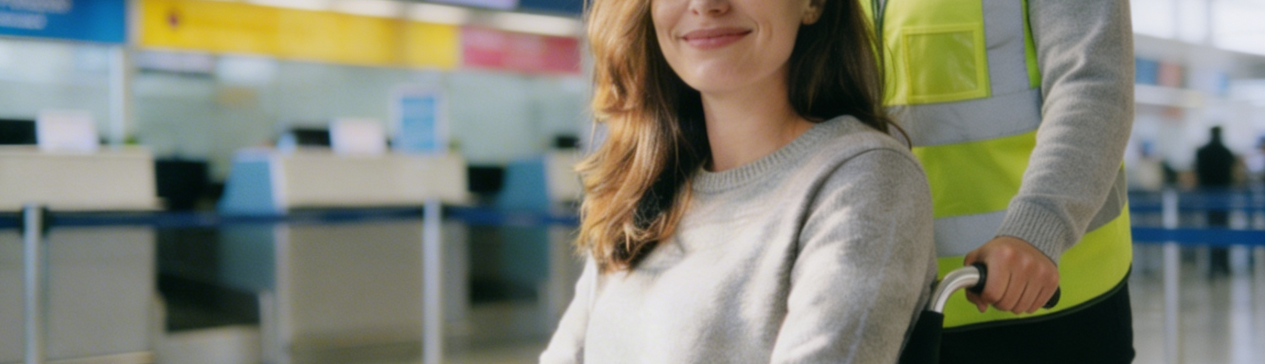
Preparation also includes knowing the environment of the departure airport. TravelAble unifies information on meeting points, assistance counters, and reserved parking spaces for people with reduced mobility. In high-traffic airports, such as Madrid Barajas, assistance staff or “green jackets” accompany the traveler from arrival to the boarding gate. Knowing the exact location of these help points, visually marked in the application, drastically reduces travel time and passenger anxiety.
The terminal experience
One of our greatest findings during the validation phase with real users was identifying security checks and boarding as the moments of greatest tension in the entire airport journey. TravelAble addresses this problem by structuring information so that the passenger knows exactly what to expect.
By using enriched AI technology, the platform ensures that airline and airport data remains updated. This not only benefits the traveler but also improves the operational efficiency of companies in the sector, reducing repetitive inquiries at counters and improving general customer satisfaction.
During boarding, clear priorities are established. The transfer from the personal chair to the aircraft chair and, finally, to the seat, is carried out with the support of specialized personnel. travelAble also includes details about the aircraft, allowing the traveler to visualize onboard amenities and the accessibility of the restrooms. This visibility is fundamental for the passenger to feel secure during the flight, knowing exactly what space they will occupy and what type of help they can request from the crew. This is where centralized information proves its value.
Connections and final destination
The journey does not end upon landing. The disembarking process and the delivery of mobility equipment are moments of great vulnerability. The system informs whether the personal chair will be delivered at the aircraft door or at the baggage carousel. In case of any damage, the tool explains the steps to follow to file an immediate claim.
Flight connections represent an additional challenge. A clear example used by the platform is Schiphol Airport in Amsterdam.
-
- If the connection time exceeds one hour, the passenger can request that their own wheelchair be delivered between flights.
- If the time is shorter, the airport provides a transit chair to ensure the connection is made efficiently.
This level of detail regarding barrier-free routes and adapted restrooms at transit points is what makes the difference between an exhausting trip and a pleasant experience.
Personalized experience
The use of standardized categories allows for personalization without fragmentation. If a passenger travels with a wheelchair that requires assistance to climb stairs but can walk to their seat, the system will filter only the information relevant to that specific profile. This capacity for immediate response to individual needs is what differentiates a static guide from a connected and dynamic solution.
The key to travelAble is that it does not offer generic data, but rather a personalized experience based on the specific needs of each person.
Looking ahead, the travelAble roadmap is ambitious. Progressive inclusion is planned to cover visual, auditory, cognitive, and hidden disabilities. The ultimate goal is to offer total disability coverage, even integrating filters for specific medical equipment such as oxygen devices. With a seamless interface aligned with accessibility standards, this tool not only simplifies planning but dignifies the travel experience, allowing the tourist’s only concern to be enjoying their destination.