


In today’s travel industry, every click counts. Travelers are no longer limited to comparing prices: they seek experiences, inspiration, and trust before taking the step to book. However, most of those millions of digital interactions are lost along the way. The big challenge for airlines, OTAs, and hotels is to turn searches into real bookings. The key lies in transforming data into personalized experiences that reduce friction and multiply conversion.
The Digital Traveler and the Era of Micro-Moments
Today, a journey begins long before buying a plane ticket or confirming a hotel room. It starts the moment someone types “best getaways in October” or searches for “flights to Lisbon from Madrid.” Every search leaves a footprint, and with it, an opportunity for travel brands.
The so-called micro-moments have become the new playing field: decisive seconds in which the traveler expects clear and fast answers. They want to know which destination to choose, what to do there, and how much it will cost. In that context, it’s not enough to display a generic list of options: success lies in anticipating intentions and offering relevant recommendations at the right moment.
The challenge is that travelers are increasingly demanding. They expect personalization without wasting time, and that pressure forces brands to rethink their digital strategies.

Travel Data: The Silent Gold of the Sector
Travel companies have a huge competitive advantage: travelers generate more data than ever before. From search histories to landing page behavior, social media interactions, or time spent on a destination map.
The problem is not the lack of information, but how to turn that volume into useful actions. Data saturation can be a barrier if it isn’t filtered and applied intelligently. This is where advanced analytics come into play, allowing segmentation of audiences, pattern detection, and adaptation of value propositions to what users are truly looking for.
A simple example: someone exploring “trips to Paris in spring” is not the same as someone comparing “best neighborhoods to stay in Paris with kids”. The first is in the inspiration phase, while the second already shows a clear booking intent. Recognizing that difference is what separates brands that inspire from those that convert.
From Inspiration to Conversion: The Role of Personalization
If e-commerce has demonstrated one thing, it is that personalization boosts conversion. In travel, this principle is even more powerful because decisions are emotional and involve high economic value.
Personalization is no longer about putting the traveler’s name in an email. It’s about designing a digital experience that recognizes their preferences and context. Showing relevant destination content, suggesting local plans based on their travel style, or tailoring recommendations according to geolocation are steps that make all the difference.
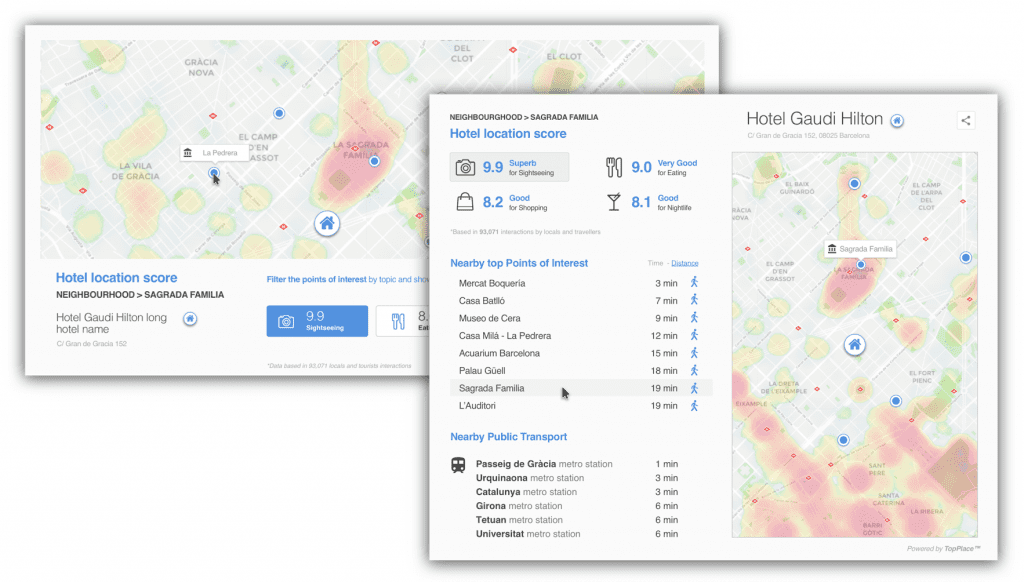
This is where solutions like those from AVUXI come in, enabling the calculation of the popularity and “location scores” of each neighborhood or area. In this way, an OTA or a hotel can not only display a map with locations but also highlight the most vibrant, safe, or recommended areas according to user interests. That extra layer of context turns a list of addresses into an invitation to experience the city differently.
The Power of Content as a Driver of Trust
Data opens the door, but what builds trust is content. Travelers want to know not only where to sleep, but what they can do at the destination, how to get around, what events will take place on those dates, or which essentials they shouldn’t miss to make the most of their stay.
Content acts as a bridge between search and booking. And it’s not about overwhelming with information, but about offering it in the right format and at the right time. In this field, companies like Smartvel are making a difference: with their destination content technology and events calendars, they allow airlines, OTAs, and hotel chains to integrate live and updated information directly into their digital channels. This way, inspiration, planning, and booking happen within the same environment, without forcing the user to jump from one website to another.
The advantage is clear: by reducing friction, trust increases—and with it, the conversion rate.
Travel Conversion: From Linear Funnel to Connected Ecosystem
The traditional sales funnel is outdated in the travel sector. Today, the customer journey is much more fluid: travelers jump from one channel to another, compare on multiple devices, and change their minds depending on the information they find.
The challenge for brands is to connect all those touchpoints into a coherent digital ecosystem. It’s no longer enough to have an attractive website or a functional app: the traveler needs to perceive continuity throughout the entire process, from inspiration to post-trip.
This requires integrating smart search engines, interactive maps, social reviews, activity calendars, and AI-powered recommendation systems. When everything fits together, the decision to book stops being a leap of faith and becomes a natural step.
Innovation and the Future: Towards Predictive Experiences
The future of travel conversion points toward predictive experiences. Thanks to the combination of travel data and artificial intelligence, brands will be able to anticipate not only what a user is searching for but also what they are likely to want in the future.
Imagine a platform that, upon detecting that a traveler is exploring flights to Tokyo in spring, automatically displays recommendations for cherry blossom festivals, food tours, and trending neighborhoods—all adjusted to their budget and travel style. That ability to connect data, context, and experience in real time will be the next big leap.
In this scenario, the boundaries between marketing, content, and product blur. Travel brands that can combine those elements will be the ones consistently turning searches into bookings.
A New Digital Pact with the Traveler
Travelers are willing to share their data as long as they perceive a clear benefit: more relevance, less noise, and an experience tailored to their needs.
Turning searches into bookings is not only a technological challenge but also one of trust. The new digital pact implies responsibility: using data ethically, transparently, and always with the goal of improving the customer experience. Those who understand this will not only increase their conversion rates but also strengthen long-term relationships with their users.