
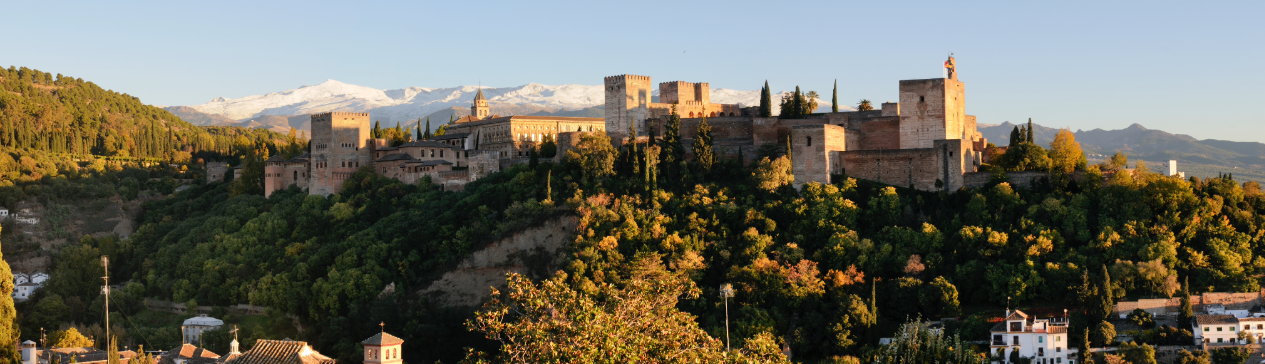

As winter approaches, the landscape changes color, and the paths and forests become covered with carpets of brown and ochre leaves that crunch beneath our feet. Autumn, with its still mild temperatures, invites us to go hiking, walk among trees painted in shades of orange and red, enjoy the crisp air, and hunt for the coveted mushrooms of the season. This third season of the year deserves a weekend getaway, or even a day trip, to explore seven of the most charming villages less than two hours from Madrid.
Buitrago del Lozoya (Sierra Norte de Madrid)
Buitrago sits on the banks of the Lozoya River, surrounded by mountains in the Sierra Norte of Madrid. It preserves a remarkable medieval legacy, showcased in its impressive walled enclosure, one of the best preserved in the Madrid region.
In autumn, the riverbanks are dressed in warm colors, and the medieval wall and the Castle of the Mendoza family stand out among golden trees.
From the upper wall, you can enjoy spectacular views of the Lozoya River and the town below. You’ll also find replicas of medieval siege machines and access to the emblematic Clock Tower in Plaza de la Constitución. The Adarve offers a route around the exterior of the Mendoza Castle and the Coracha, a defensive structure that connects with the river. From the Romanesque Arrabal Bridge, you get one of the most iconic views of the village.
Don’t miss the free Picasso collection donated by Eugenio Arias, a close friend of the artist.
Patones de Arriba (Community of Madrid)
About 60 kilometers northeast of the capital lies this small village hidden in the rugged Valle del Jarama, which forms the natural border between Madrid and Guadalajara. Its remote location has allowed Patones de Arriba to preserve its unique charm, with winding streets and black slate buildings, an outstanding example of the region’s famous “black architecture.”
Today, the old village is full of traditional restaurants, organic shops, artisan workshops, and charming guesthouses, giving it a timeless feel. In 1999, it was declared a Site of Cultural Interest for the preservation of its architectural heritage and rural landscape.
One of the best ways to reach it is via the El Barranco Ecological Trail, which starts from Patones de Abajo and climbs for about 20 minutes, offering mountain views along the way. At the entrance to the village stands the 17th-century Church of San José, now housing the local tourist office.
For hiking enthusiasts, there are several routes such as the Cancho de la Cabeza Trail, the Arroyo Path, and the El Barranco Ecological Trail. Cyclists can follow trails along the Patones stream, toward El Berrueco, or along the Genaro Trail.
In November, the popular “Month of Stews” (Mes de los Callos) celebrates hearty traditional dishes, perfect for chilly autumn days.
Cercedilla (Sierra de Guadarrama)
Cercedilla has long been a key stop between Madrid and Segovia, nestled in the Sierra de Guadarrama just an hour from the capital. Of Roman origin, as evidenced by the ancient Roman road still visible and walkable, the village is easily accessible by car, bus, or train.
From its picturesque train station departs the Nature Train, an educational experience for both children and adults. Hikers can enjoy trails such as the Poets’ Route, the Roman Road, the Schmidt Trail, Las Dehesas Route, and the Water Trail.
For a cultural plan, visit the Fábrica de la Luz or the Ski Museum, dedicated to the legendary skier Paquito Fernández Ochoa.
Rascafría (Sierra de Guadarrama)
Rascafría is a charming village about 100 kilometers north of Madrid, nestled in the beautiful valle del Lozoya, within the Sierra de Guadarrama. Surrounded by rivers and forests, it’s an ideal spot for nature lovers.
The highlight is the Monasterio de Santa María del Paular declared a Site of Cultural Interest. It blends several architectural styles, with its flamboyant Gothic façade standing out. The monastery is still inhabited by Benedictine monks who produce true artisanal treasures like local honey, cheese, and liqueurs.
Nearby, the Puente del Perdón (“Bridge of Forgiveness”) offers one of the most stunning views of the monastery. You’ll also find historical buildings like the Molino de papel de los Batanes, which produced the paper used for the first edition of Don Quixote.
In the village center, landmarks include the Trastámara Square, the neo-Mudejar-style Town Hall, and the 15th-century Church of San Andrés Apóstol. In autumn, the town hosts its Mushroom, Game, and Wine Gastronomic Days, when local restaurants serve seasonal dishes.
After a hearty meal, you can stroll along the “Blue Walk,” a charming urban route following the Artiñuelo stream, or escape into the enchanting Finnish Forest, a magical setting of trees, ponds, and a wooden sauna that feels straight out of northern Europe.
Chinchón (Community of Madrid)
Chinchón is one of the most picturesque villages in the Madrid region. Its medieval Plaza Mayor is the beating heart of the town, and one of the most photographed squares in Spain.
Surrounded by green-painted wooden balconies, this arcaded square has hosted markets, festivals, bullfights, and film shoots. From here, cobbled streets lead to the Iglesia de Nuestra Señora de la Asunción, which houses a painting by Goya, and to the Lope de Vega Theatre.
At the top of the hill stands the 15th-century Castle of the Counts, an imposing fortress (not open to the public) that dominates the landscape. Nearby are the Convent of the Poor Clares and the Monastery of San Agustín, completing Chinchón’s monumental charm.
Sigüenza (Guadalajara)
Sigüenza lies about 130 kilometers from Madrid, in northern Guadalajara province (Castilla-La Mancha). This medieval city rises on a hill beside the Henares River and has witnessed centuries of history.
Its castle, now a Parador Nacional, dominates the skyline and offers a privileged view of the old town. From there, cobbled streets wind through the Travesañas, the medieval quarter.
The magnificent Cathedral of Santa María blends several architectural styles and houses the famous tomb of the Doncel of Sigüenza, a funerary sculpture that has become the city’s emblem.
The town’s stately atmosphere continues through squares like Plaza del Obispo and Plaza del Castillo, and buildings such as the Doncel House and the Church of San Vicente. Nearby natural attractions include the Barranco del Río Dulce Natural Park, ideal for hiking lovers.
Cadalso de los Vidrios (Sierra Oeste, Community of Madrid)
Cadalso de los Vidrios lies in the southwest of the Madrid region, in the Sierra Oeste, close to the provinces of Toledo and Ávila. This picturesque town, once a royal retreat, boasts a rich historical and artistic heritage.
You can visit the Palace of Villena, an 18th-century former royal residence now used for cultural events, and the Iglesia de Nuestra Señora de la Asunción, a Gothic-Renaissance gem declared a Site of Cultural Interest.
The surrounding landscape offers trails through vineyards and scenic spots like Cabeza Reina Hill. The town is also known for its traditional glassmaking, still celebrated in local artisan workshops. In autumn, hiking routes such as the Arroyo Tórtolas Trail showcase the beauty of the changing landscape.
With all these destinations, there’s no excuse not to plan a weekend getaway or a day trip to breathe fresh air, take in the magnificent colors of autumn, and enjoy delicious Castilian cuisine.